Learn by Doing Activity #003 How Many Tiles Will It Take? Surface Area

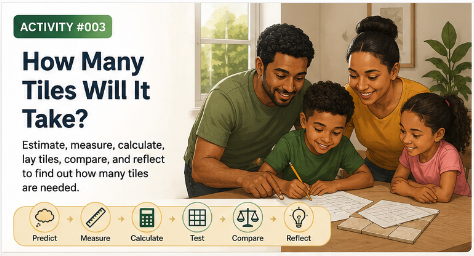
How Many Tiles Will It Take?

Can you estimate how many tiles are needed for a small rectangular surface? Make a prediction, measure the surface and one tile, calculate by hand, test with real or paper tiles, and compare your result.

25-40 min Beginner

Check your work: nxperspectives Tile Calculator

Family looking at a small rectangular surface and predicting how many tiles will fit.
Start with an estimate before laying tiles.

Learn by Doing

Predict Measure Calculate Test Compare Reflect
Real-World Challenge

Set up

Materials

Use small, safe materials and a surface that is easy to measure.

Materials Required

Required

  • Tape measure or ruler
  • Paper
  • Pencil
  • Calculator

Suggested surfaces

  • Small tabletop
  • Poster board
  • Piece of cardboard
  • Foam board
  • Small section of floor
  • Small section of wall

Suggested tiles

  • Sample floor tiles
  • Cardboard squares
  • Paper squares
  • Foam squares
  • Plastic tiles
  • Equal-size square objects

For testing

  • Real sample tiles
  • Paper or cardboard tiles

Safety note

Keep the project small. Do not remove flooring, install tile, use sharp tools, or start a construction project for this activity.

1

Predict

Estimate the tile count first.

Look at the surface and one tile, then make your best guess before measuring.

  • Choose one small rectangular surface.
  • Choose one tile or paper tile size.
  • Predict how many tiles will cover the surface.
  • Explain why your estimate feels reasonable.
2

Measure

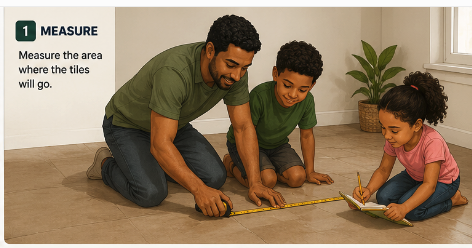
Measure the surface and one tile.

Only measure dimensions at this stage. Do not lay out the finished tile pattern yet.

  • Surface length: measure the long side of the rectangle.
  • Surface width: measure the short side of the rectangle.
  • Tile length: measure one side of the tile face.
  • Tile width: measure the other side of the tile face.
  • Units: keep all measurements in the same unit.
Family measuring a small rectangular surface and one tile without showing a completed tile layout.
Measure first so the test has something to check.
3

Calculate by hand

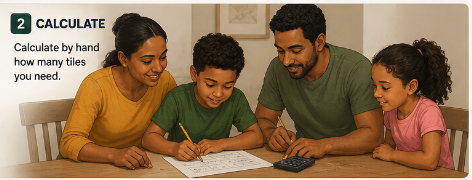
Find the surface area and tile area.

Use area to estimate how many tiles the small surface needs.

Simple estimate

Tiles needed ≈ surface area ÷ area of one tile

Surface area = length x width. Tile area = tile length x tile width.

  • Calculate the area of the surface.
  • Calculate the area of one tile.
  • Divide the surface area by the tile area.
  • Round up when the surface cannot be covered by a partial final tile count.
Handwritten calculations showing surface area, area of one tile, and tiles needed.
Show the arithmetic before checking with a calculator.
4

Test

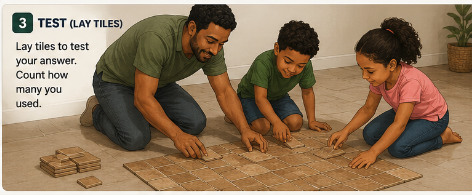
Lay tiles on the measured surface.

Use real sample tiles or paper/cardboard tiles to verify the hand calculation.

  • How many full tiles fit across the length?
  • How many full tiles fit across the width?
  • Are there leftover spaces or partial-tile areas?
  • Does the tile test visually match your hand calculation?
Family placing paper tiles or sample tiles on the measured rectangular surface to test the calculation.
Laying tiles turns the area estimate into a visible count.
5

Compare

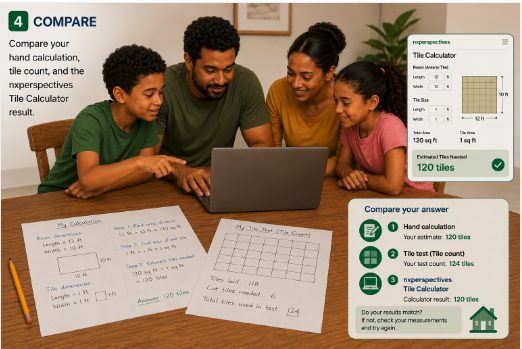
Compare with the nxperspectives Tile Calculator.

Use the calculator after your hand calculation and tile test.

Check your work

nxperspectives Tile Calculator

Enter your measured surface and tile dimensions, then compare the result with your work.

Open Tile Calculator
  • Compare the hand calculation, tile test, and calculator result.
  • Discuss differences caused by rounding, gaps, tile size, or partial spaces.
Family comparing a hand calculation, tile test count, and a callout for the nxperspectives Tile Calculator.
The calculator is a check, not the starting point.
6

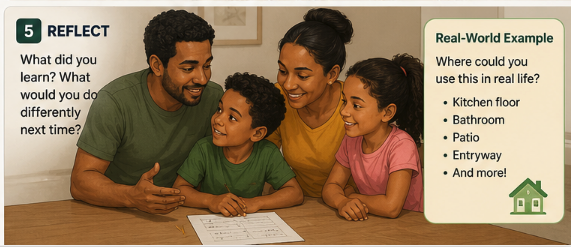
Reflect

Think about why the numbers changed.

Tile estimates often change once you see the pattern on the surface.

Reflection questions

  • Was your prediction close?
  • Which result was largest: prediction, hand calculation, tile test, or calculator?
  • Where did rounding affect the answer?
  • Did the tiles fit evenly into the surface?
  • What would you measure more carefully next time?
7

Apply

Real-World Challenge

Find another small tiled surface and estimate how many tiles it might need.

Move beyond the first surface

Try the same process with a small bathroom floor, backsplash, laundry room area, entryway, or patio section. Keep the project realistic and explain what you measured and assumed.

Family looking around the home for another small tiled surface such as a bathroom, backsplash, entryway, or patio.
Real estimates include assumptions, partial tiles, gaps, and layout choices.

Printable activity sheet

Activity Sheet #003: How Many Tiles Will It Take?

Download the companion worksheet to record the prediction, measurements, hand calculation, tile test, calculator comparison, reflection, and Real-World Challenge in one place.